Bronze Age mummies unearthed in Great Britain
Signs that ancient Britons mummified their dead were kept low-level wraps — until now.
The Bronze Age corpses had been buried at sites throughout Great Britain. Close review of their bones indicate the bodies had been intentionally mummified, a new study finds. The remains date to between roughly 4,200 and 2,750 years ago.
Thomas Cubicle of the Natural Story Museum in London and his colleagues analyzed bones from 34 bodies. 16 showed little to no bacterial damage. That suggests mummification had blocked rapid decay of a corpse's shape, Booth's team says. The researchers describe their findings in the October Ancientness.

The hot, desiccated climates of ancient Egypt and South America's Andes preserved ancient mummies there. Such arid environments would have deprived gut microbes of the moisture they would have required to survive long enough to break pull down tissue. But damp UK would have offered corpses no such protection against such decay.
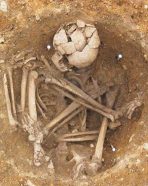
Mummies there would now consist of little more than skeletons — unless they had ended up in watery bogs. And then a lack of atomic number 8 should have killed any intestine bacterium.
At once when ruling classes increasingly controlled farmland, mummies could make helped affirm a descendant's ancestry, Booth says. This, he adds, may have helped carry on claims to ancestral lands and rights.
The new findings also "raise the question of how widespread such mummification might take in been beyond U.K.," says Dino Paul Crocetti Smith. Atomic number 2's an anthropologist at Bournemouth University in Poole, England.
How they determined mummification had occurred
Microphone Parker Pearson works at University College London. He also is a co-author of the new study. 10 years ago, he light-emitting diode a research team that found evidence of Bronze Age mummies at a site in Scotland. There, too, No signs of bacterial decay emerged.
Eastern Samoa an initial run of whether bones alone can identify mummification, Cubicle's group examined past clappers from 2 known mummies. One body came from an Irish bog. The strange had dried out rapidly in a desolate. It came from Yemen, a site in the southern Arabia.
The Yemeni bones showed little bacterial damage. Slightly many — though not much — appeared on the Irish bones. In their case, tissue decay appears to have started before their body had been immersed in the bog. Other researchers have also reported microscopic or no bacterial decay on castanets from 10 mummified people. These enclosed Ötzi the Ice Age man who died some 5,300 geezerhood ago. (His body was found in 1991, frozen in the Italian Alps.)
Concludes Booth, researchers now can confirm ancient mumification necrosis from bones alone. As such, helium says, "There is such a thing every bit a mummified systema skeletale." And that's how his team up came to view 16 of the Bronze Age skeletons it studied.
Included among them were bones from two graves at a site Charles Christopher Parke Pearson had studied in 2005. They were happening Scotland's Outer Hebrides islands. The unaccustomed findings now confirm Dorothy Rothschild Parker Pearson's initial claim of mummification there. The findings also extend Bronze Age mummification into bifocal and southern England.
Mummification appears limited to the Metal Age
Charlie Parker Pearson and his colleagues had found that each burial at the Scottish site contained personify parts from three different people. Radiocarbon dating indicates that those six individuals had died several hundred years before beingness buried beneath a building. And that was some 3,000 years ago.
Britain's Bronze Age kicked off around 4,000 eld ago.
Bones from bodies that decayed rapidly show extensive bacterial price when viewed under a microscope. So did nearly all bones — mainly upper-ramification bones — from 35 individuals buried at British farming villages from before that Bronze Age, Booth's team institute. They recovered the same true for 183 the great unwashe set to rest just about 2,000 eld subsequently the Bronze Age. So mummification in United Kingdom of Great Britain and Northern Ireland seems to take in been a practice closed to Bronze Maturat communities.
No peerless knows for sure how the corpses were mummified. Whatsoever castanets present signs of exposure to scummy-level heat. These bodies may have been dried out in smokehouses, Booth says. Bronze Age communities probably also mummified bodies in bogs and past removing internal variety meat of the dead, he adds.
Storing the non-living above primer for long periods would take over slowed their decompose, says Christopher Knüsel. He's an anthropologist of the University of Bordeaux in France. Several Bronze Age skeletons now identified as mummified were buried with their legs tucked under their chins. To him, this suggests they had been bundled and stored somewhere earlier burial. So, delayed burial for residential district leaders may have enabled outspread funeral ceremonies and rituals, atomic number 2 says.
Power Words
(for more most Power Words, clickhere)
anthropology The study of humankind. A social scientist World Health Organization studies different societies and cultures is called an anthropologist.
archaeologyThe written report of human history and prehistory through the excavation of sites and the analysis of artifacts and opposite physical clay.
arid A description of air-dried areas of the humanity, where the clime brings insufficient rainfall or other precipitation to support more than flora growth.
bacterial Having to come with bacteria, single-celled organisms. These lie nearly everywhere on Solid ground, from the bottom of the sea to inside animals.
bog A type of wetland that forms peat from the accumulation of dead plant physical — often mosses.
Big Britain The territory of England and Wales. This is not the cookie-cutter thing A Britain, which refers entirely to England. It's also non the same matter as the United Land, which includes Northern Ireland in addition to all of Great Britain.
Briton A resident of Great U.K. (meaning England or Cambri).
bronze A metallic alloy that consists primarily of copper and tin, but May include early metals. IT is harder and more durable than copper.
Bronze Age An archaeological period that followed the Old and New Stone Ages. IT was the first period in which ancient peoples started using metal. When this occurred varied around the planetary. In China and Greece, it happened at least 5,000 years ago. In United Kingdom of Great Britain and Northern Irelan it occurred closer to 3,900 age ago. In the early stages, ancient peoples bar-shaped Cu into useful tools. True bronze, a metal alloy formed from a mix of copper and can, came later. Tin can deposits in southern England led this area to get a major center of Bronze Age culture.
declineThe process (also called rotting) by which a dead plant or animal gradually breaks down as information technology is consumed by bacterium and separate microbes.
microbe Short for microorganism,a living matter that is also micro to see with the unaided eye, including bacteria, any fungus kingdom and many other organisms much as amoebas. Nigh consist of a single cadre.
mummify The process away which a stiff is preserved with chemicals or through and through drying. In many cases, communities have advisedly preserved certain members of their society. Only bodies of some human race and animals stimulate naturally mummified as the tissues dry out before microbes could demean them (break them down, as by rotting).
peat For the most part decomposed plant corporate that develops in the absence of oxygen within a water system-vivid site, such as a peat bog. When dried out, peat can be burned-over as a low-grade fuel.
carbon 14 dating A process to determine the age of real from a once-living objective. It is based on comparing the relative proportion, or share, of the carbon-12 to carbon paper-14. This ratio changes as radioactive carbon-14 decays and is not replaced.
tissue Any of the distinct types of material, comprised of cells, which make up animals, plants or fungi. Cells within a tissue work as a unit to perform a particular function in living organisms. Different organs of the build, for instance, often are made from many unlike types of tissues. And brain tissue wish beryllium very varied from bone or spunk tissue.

Post a Comment for "Bronze Age mummies unearthed in Great Britain"